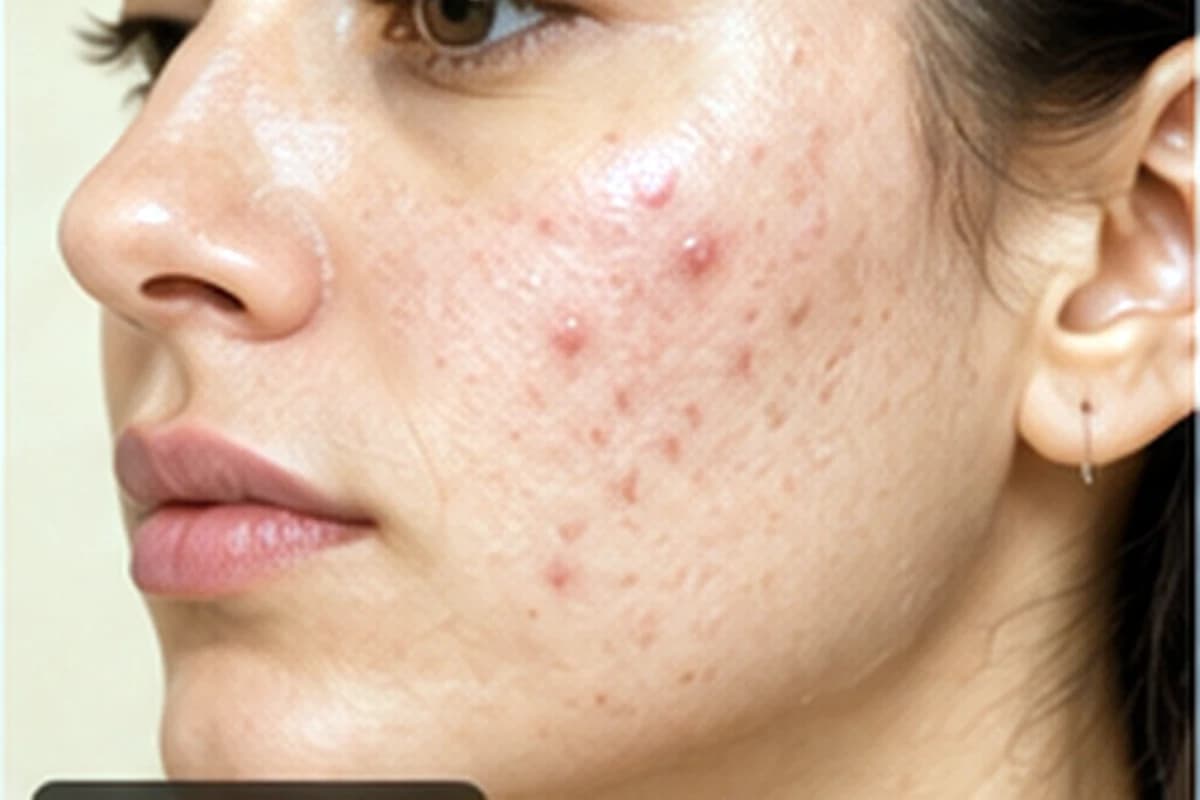
"I Never Had Acne as a Teenager. Why Am I Getting It Now?"
You crossed your teenage years with relatively clear skin.
Then, somewhere in your 20s or 30s, things suddenly changed.
A few painful pimples appeared around your chin or cheeks. Then another breakout followed. You changed your face wash, bought an acne serum, stopped using makeup, reduced sugar, tried a "skin detox" and perhaps spent thousands of rupees on skincare products.
The acne improved for a few days.
Then it came back.
At some point, the question changes from:
to:
If that sounds familiar, you are not alone.
Adults can develop acne even if they had relatively clear skin during their teenage years. Dermatologists refer to acne that begins for the first time in adulthood as . Acne may also persist from adolescence or disappear for years and return later. The American Academy of Dermatology notes that adult acne can continue into the 30s, 40s and even beyond.
The important question is not simply whether adult acne exists.
It is
Adult Acne Is Not Always Just a "Skincare Problem"
When acne appears, most of us naturally look at what we are applying to our face.
Was it the new moisturiser?
Is the sunscreen clogging my pores?
Should I switch cleansers?
Do I need salicylic acid?
Would retinol help?
These can all be relevant questions. But acne is more complex than having "dirty" or inadequately cleansed skin.
Acne is an inflammatory condition involving several factors, including oil production, blockage of hair follicles, inflammation and biological activity within the follicle. Genetics and hormonal influences can also contribute, while factors such as certain cosmetics, medications, stress and dietary patterns may affect some individuals.
Research on adult female acne in particular suggests that its causes are often multifactorial rather than the result of one single trigger. Hormonal pathways—especially androgen-related signalling—appear to play an important role in some patients.
That is why buying another face wash may not necessarily solve recurring acne.
Sometimes the first step is not adding another product.
It is understanding the pattern.
What Does "Hormonal Acne" Actually Mean?
"Hormonal acne" has become one of the most frequently used phrases on Instagram, YouTube and skincare forums.
A breakout around the jawline?
"Hormonal."
Acne before a period?
"Hormonal."
Sudden acne after 25?
"Hormonal."
But medically, the situation is more nuanced.
Hormones—including androgens—can influence the sebaceous glands and oil production involved in acne development. Hormonal fluctuations can also explain why some women notice predictable worsening around their menstrual cycle.
Adult female acne is particularly associated with hormonal influences, and hormonal therapies can be useful for appropriately selected patients.
However,
Having acne on your chin or jawline does not automatically mean you have PCOS.
And having acne in adulthood does not automatically mean that your hormones are "imbalanced."
A dermatologist needs to consider the complete picture.
Does Adult Acne Mean You Have PCOS?
No.
This is one of the most important misconceptions to clear up.
Polycystic ovary syndrome, or , can be associated with acne because increased androgen activity is one of the features that may occur with the condition.
But acne alone is not enough to diagnose PCOS.
The 2023 International Evidence-based Guideline for PCOS specifically states that .
In other words:
A clinician may become more interested in investigating hormonal causes when acne occurs alongside other relevant signs or symptoms, such as:
- irregular, infrequent or absent menstrual periods
- increased coarse facial or body hair
- scalp hair thinning or female-pattern hair loss
- difficulty with ovulation or fertility
- other clinical signs suggesting increased androgen activity
- a known history of PCOS or another hormonal disorder
The exact assessment differs from person to person.
This distinction matters because unnecessarily labelling every episode of adult acne as PCOS can lead to anxiety, unnecessary tests and inappropriate treatment.
What About Insulin Resistance and Acne?
This is another topic receiving enormous attention online.
And there is some biological reasoning behind the conversation.
Insulin and insulin-like growth factor-1, or , interact with pathways involved in sebaceous-gland activity, keratinisation and androgen signalling.
A 2025 systematic review examining the causes of adult female acne found evidence linking high-glycaemic dietary patterns, insulin/IGF-1 signalling and androgen pathways with acne development.
But this does mean:
Nor does it mean everybody with persistent pimples needs an insulin test.
That distinction is important because people increasingly arrive at dermatology clinics after diagnosing themselves through social media.
You may have acne without insulin resistance.
You may have insulin resistance without acne.
And in some individuals, both may occur together.
The job of proper medical assessment is to determine whether there is enough reason in your individual case to investigate further.
"But My Periods Are Regular. Can My Acne Still Be Hormonal?"
Yes, hormonal influences on acne can still exist even when menstrual cycles appear regular.
But again, that does not automatically imply PCOS or another endocrine disease.
Hormonal activity within the skin and sensitivity of sebaceous glands to androgens can matter even when routine hormonal testing is not dramatically abnormal.
This is one reason adult acne can sometimes become frustrating.
A patient may think:
The answer is that acne is not controlled by one laboratory number.
Genetics, androgen sensitivity, sebaceous activity, inflammation, skincare habits and environmental influences may all interact.
A normal test result does not mean the acne is imaginary.
And persistent acne does not necessarily mean an abnormal hormonal test will be found.
Does Everyone With Adult Acne Need Hormone Tests?
No.
This is another area where the internet can create unnecessary confusion.
Someone with mild adult acne and no other relevant symptoms may not require an extensive panel of hormonal or metabolic investigations.
On the other hand, a clinician may consider further investigation when the history or examination suggests an underlying hormonal condition.
The decision may depend on factors such as:
Did it appear gradually or very suddenly?
Has there been a recent change?
A 2025 review on hormonal assessment in adult female acne similarly emphasised that isolated acne is not a reliable marker of androgen excess and that investigations should be guided by clinical features suggesting hormonal abnormalities.
The key message is simple:
Why Does My Acne Keep Coming Back?
This is often the most frustrating part of adult acne.
You finally get the breakout under control.
Your skin looks better for two weeks.
Then another painful pimple appears.
Recurring acne can happen for several reasons.
Sometimes treatment has been stopped too early.
Sometimes maintenance therapy is required.
Sometimes the original treatment was suitable for one component of the problem but not another.
Hormonal influences may continue.
A skincare product may be contributing.
And sometimes what appears to be "treatment-resistant acne" needs another diagnostic look.
Acne treatments also require time. The American Academy of Dermatology notes that visible improvement generally takes several weeks rather than a few days.
This is why constantly changing products every week can sometimes make acne management even more confusing.
"The Pimple Goes Away, but the Dark Mark Stays"
For many Indian patients, active acne is only half the problem.
The pimple disappears.
But a brown or dark patch remains for weeks or months.
This is commonly called .
And psychologically, it can sometimes become more frustrating than the original breakout because every new pimple can leave another visible mark.
This is an important distinction:
They may require different strategies.
Controlling recurring inflammation is usually important before repeatedly trying to remove the marks it leaves behind.
Once active acne is reasonably controlled, pigmentation or true acne scars can be assessed separately and managed according to the person's skin type and the type of mark or scar present.
Are You Treating Acne—or Constantly Treating the Damage Left by Acne?
This is worth asking if you have been struggling for months.
Some people enter a cycle like this:
Months later, the bathroom shelf is full.
But the underlying acne is still active.
A more useful approach is often to separate the problem into stages:
understand and control active acne.
prevent new lesions as much as possible.
treat persistent pigmentation.
assess genuine acne scarring once active disease is under control.
That sequence can prevent patients from spending heavily on procedures for acne marks while continuing to develop new acne every month.
When Should You See a Dermatologist for Adult Acne?
Mild acne can sometimes respond to appropriately chosen over-the-counter care.
But professional evaluation becomes particularly useful when:
- acne is painful, deep or cystic
- breakouts are leaving dark marks or scars
- acne suddenly appears or becomes significantly worse
- treatment repeatedly fails
- acne is affecting confidence or daily life
- breakouts occur alongside symptoms suggestive of hormonal problems
- you are unsure whether what you have is actually acne
- you are spending repeatedly on skincare without understanding the cause
The American Academy of Dermatology advises dermatology assessment particularly for deeper painful acne or acne that is producing scars, since over-the-counter products may be insufficient for these cases.
What Should a Proper Adult-Acne Consultation Look At?
A good acne consultation should involve more than simply looking at your face and handing you a list of products.
Depending on the patient, assessment may include:
your age and when the acne started,
the type and distribution of acne,
previous treatments and how you responded,
menstrual and hormonal history where relevant,
hair growth or scalp-hair changes,
medical conditions and medications,
current skincare and cosmetic products,
lifestyle factors that may be relevant,
and whether further laboratory evaluation is actually indicated.
Only after understanding the pattern should treatment be planned.
For one patient, the answer may primarily involve topical acne medication.
Another may need oral treatment.
Someone else may need evaluation for hormonal factors.
And another patient may need treatment for both active acne and the pigmentation or scarring it has already caused.
There is no single "adult acne package" that is right for everyone.
The Question Is Not "Which Acne Treatment Is Best?"
The better question is:
If you suddenly develop acne in your 20s or 30s, it does not automatically mean that something is seriously wrong.
It also does not automatically mean you have PCOS, insulin resistance or a hormonal imbalance.
But persistent, recurrent or severe adult acne deserves more than trial-and-error skincare.
The pattern of your acne, your medical history, associated symptoms and previous treatment response can all help determine whether the problem is primarily dermatological or whether broader evaluation may be useful.
At , the aim of an adult-acne assessment should be to understand the cause and pattern before deciding on treatment—particularly when acne keeps returning, produces pigmentation or scarring, or appears alongside other possible hormonal concerns.
Because sometimes what your skin needs isn't another serum.
Yes. Adult-onset acne is well recognised, and some people experience acne for the first time in adulthood.
No. The location of acne by itself cannot diagnose a hormonal disorder. Hormonal factors may contribute, but medical history and other symptoms need to be considered.
No. Acne can occur in people with PCOS, but acne alone is considered a relatively weak predictor of biochemical hyperandrogenism.
Insulin and IGF-1 pathways may contribute to acne development in some people, but acne itself cannot diagnose insulin resistance.
Not necessarily. Testing should generally be based on the patient's history, examination and presence of other signs suggesting an underlying hormonal condition.
Inflammation can trigger excess pigment production, producing post-inflammatory hyperpigmentation. Controlling new acne is therefore an important part of preventing additional marks.
In many cases, controlling ongoing acne is the priority. Once new breakouts are better controlled, persistent pigmentation and scarring can be assessed separately.
This article is intended for general educational purposes and does not replace an individual medical consultation. Acne and hormonal symptoms can have multiple causes, and investigations or treatment should be selected according to an individual's clinical history and examination.