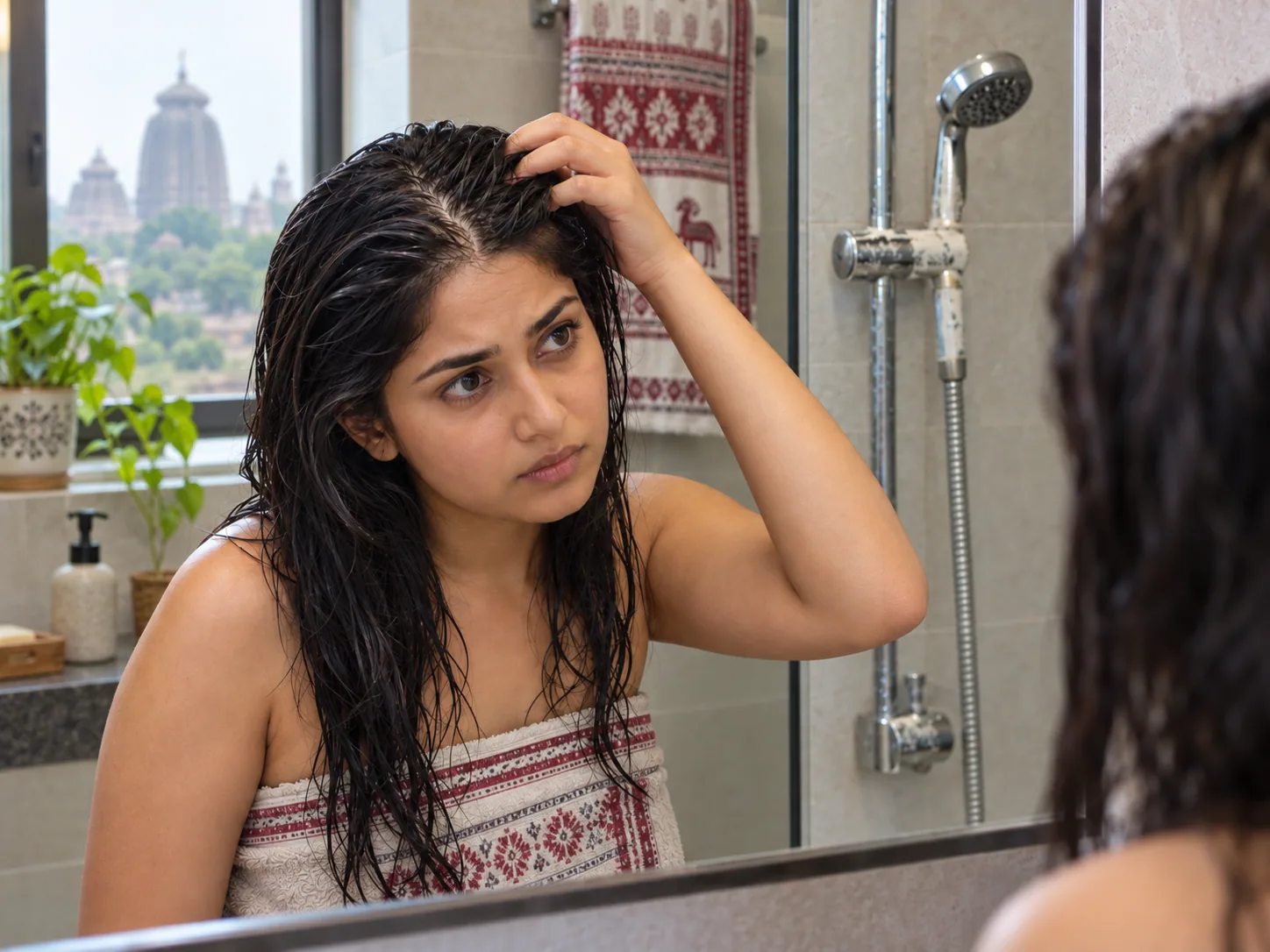
You move to Bhubaneswar for college, a new job or a new home.
A few weeks or months later, your hair suddenly feels different.
It seems rougher. More frizzy. Your scalp may feel dry or itchy. And then you start noticing more strands in the bathroom, on your pillow or while combing.
Someone tells you,
You search online and find people saying exactly the same thing. Someone recommends a shower filter. Someone else tells you to wash your hair with RO water. Another person says Bhubaneswar water is perfectly fine and that your hair fall has nothing to do with it.
So who is right?
The answer is more nuanced than either side suggests.
If you are genuinely losing hair density, blaming the water without identifying the type of hair loss can delay the treatment you actually need.
First, Is Bhubaneswar Water Really "Hard"?
There is no single answer because there is no single type of water being used across every home in Bhubaneswar.
A study examining piped water across all found considerable variation in water hardness between different parts of the city. Hardness ranged from approximately . The south-east zone had the highest average hardness among the three zones studied.
This tells us something important:
And the water reaching your hair may also depend on whether your building uses municipal piped water, groundwater, borewell water, tanker water or a combination of sources.
That helps explain why online conversations about Bhubaneswar water can sound contradictory.
In one recent local discussion, a person who had recently shifted to Bhubaneswar complained of a dry scalp and frizzy hair, while another user blamed humidity and hard water.
In another Bhubaneswar discussion, someone returning from Bengaluru described the opposite experience—their hair actually felt better after using Bhubaneswar water.
Both experiences can be genuine.
The mistake is assuming that either experience proves what is happening to hair.
The Bigger Question: What Do You Mean by "Hair Fall"?
This is where much of the confusion begins.
When people say, "My hair is falling," they may actually be describing three very different problems.
The hair shaft itself snaps somewhere along its length.
You may notice shorter broken strands, rough or frizzy hair, split ends, uneven lengths and hair that seems difficult to manage.
Because broken pieces appear in your hands, on your clothes or in the bathroom, it can look like severe "hair fall."
But the follicle may still be producing hair normally.
Here, the entire strand is released from the follicle.
Some shedding is part of the normal hair cycle, but an obvious increase can occur for many reasons.
Illness, significant stress, rapid weight loss, nutritional problems, hormonal changes and other triggers can contribute to increased shedding in some people.
This is different again.
Someone may notice a progressively wider parting, thinning over the crown, receding temples, reduced overall density or increasing visibility of the scalp.
This can occur with conditions such as pattern hair loss and requires a very different assessment from simple hair-shaft breakage.
That distinction matters because
So What Can Hard Water Actually Do to Hair?
Hard water contains higher concentrations of dissolved minerals, particularly calcium and magnesium salts.
Research looking at the effect of hard water on hair has produced mixed but interesting findings.
One laboratory study found significantly reduced tensile strength in hair repeatedly exposed to hard water, suggesting that hard water may make the hair more vulnerable to breakage.
Another study examining hair under a scanning electron microscope found greater mineral deposition on hard-water-treated hair, although it did not find a significant difference in visible structural surface damage.
A separate study reported increased mineral deposition and changes in the appearance and thickness of hair shafts exposed to hard water.
At the same time, an earlier controlled study did find a statistically significant difference in hair tensile strength or elasticity between hard-water-treated and distilled-water-treated hair.
So the scientific answer is not:
A more accurate interpretation is:
That is a very important difference.
"But My Hair Fall Started Only After I Moved to Bhubaneswar"
This is probably the strongest reason people blame water.
And the timing should not simply be dismissed.
But moving to another city usually changes much more than the water.
Think about what else changed around the same time.
Did your diet change after moving into a hostel or PG? Has your sleep become irregular? Are you under more academic or work-related stress? Have you recently lost weight? Did you have dengue, COVID, another fever or surgery a few months earlier? Has dandruff or scalp itching increased? Are you heat-styling or chemically treating your hair more frequently? Did you start any new medication? Is there a family history of thinning or baldness?
The important point is not that one of these be the reason.
It is that a recent change in water is only .
People naturally connect two events that happen close together:
Sometimes that hypothesis may partly explain changes in the hair shaft.
Sometimes it may have very little to do with the actual reason hair density is decreasing.
Dandruff Makes the Story Even More Confusing
This is another pattern appearing in Bhubaneswar hair discussions.
One recent local Reddit user described having dandruff for around a year followed by rapid hair fall and was looking for a dermatologist in Bhubaneswar. The resulting conversation quickly moved into questions about treatment, genetic hair loss and whether proper assessment was needed.
If your scalp is itchy, flaky, inflamed or uncomfortable, the question should not simply be:
The scalp itself may need evaluation.
Changing shampoos repeatedly without knowing what scalp condition you are dealing with can make the situation even more confusing.
Should You Buy a Shower Filter?
It depends on what problem you are trying to solve.
If you suspect that your water source contains high levels of minerals and your main concern is roughness, buildup or hair texture, investigating your actual water source is more useful than assuming that all Bhubaneswar water is identical.
But if your concern is:
a widening parting, visibly reduced density, receding hairline, thinning crown, bald patches or persistent heavy shedding,
then changing the shower head should not become a substitute for finding out what type of hair loss you have.
You could theoretically improve hair texture while the underlying cause of progressive thinning continues.
Before Blaming the Water, Ask These 10 Questions
- Am I seeing , or are full-length strands coming out?
- Is my hair becoming rougher, or is my ?
- Is my parting gradually getting wider?
- Has my hairline or crown changed?
- Did I recently have significant stress, illness, fever, surgery or major weight loss?
- Has my diet changed since moving?
- Do I have persistent dandruff, itching, redness or scalp discomfort?
- Is there a family history of pattern hair loss?
- Did the problem begin after a new medication, hormonal change or major lifestyle change?
- Has the shedding continued or worsened despite changing shampoos, oils or water?
Your answers won't provide a diagnosis by themselves.
But they help explain why simply asking may be asking the wrong first question.
A better question is:
When Should Hair Fall Be Properly Evaluated?
Consider a dermatology assessment when you are noticing a meaningful reduction in density, progressive thinning, a widening part, receding temples, bald patches, persistent heavy shedding or significant scalp symptoms.
The purpose is not automatically to prescribe a procedure.
It is to understand
That concern is clearly present among Bhubaneswar patients online. In a July 2026 local discussion, a 26-year-old woman experiencing heavy hair fall and thinning specifically wanted to know whether doctors would examine the scalp, perform blood or hormonal investigations when appropriate, explain the diagnosis and provide sustainable results rather than simply advertise treatments.
Another Bhubaneswar user with severe hair fall similarly asked whether the problem could be genetic or related to a deficiency.
Those are sensible questions.
According to the American Academy of Dermatology, evaluating hair loss typically starts with the history and examination of the scalp and hair. Blood testing or other investigations may be recommended when the dermatologist suspects issues such as nutritional deficiencies, hormonal problems, disease or infection. Not everybody automatically requires exactly the same laboratory tests.
What Should a Hair-Loss Consultation Try to Establish?
A useful assessment should first determine whether the problem looks like breakage, excessive shedding, patterned thinning, a scalp disorder or a combination of issues.
The history matters: when it started, whether the onset was sudden or gradual, recent illness, medication, diet, stress, family history and other relevant changes.
The scalp and hair should then be examined. Depending on the findings, closer examination such as trichoscopy and selected investigations may be considered.
Only does it make sense to discuss treatment options.
This matters because PRP, GFC, minoxidil, supplements, anti-dandruff therapy and hair transplantation are not interchangeable solutions to one condition called "hair fall."
Different problems require different strategies.
Hard Water or Hair Loss? A Simple Way to Think About It
If the biggest change is , hair-shaft damage and breakage deserve attention.
If you are finding increasing numbers of , the causes of excessive shedding need to be considered.
If you are seeing a , you may be dealing with an actual loss of hair density rather than simply damaged hair shafts.
And if you have , the scalp itself may need assessment.
More than one of these can happen at the same time.
That is why photographs taken every few weeks under similar lighting can sometimes be more informative than repeatedly counting hairs in the shower.
Frequently Asked Questions
Water hardness varies across Bhubaneswar. Research on the city's piped water found substantial variation between different wards and zones, meaning one resident's water experience may not represent the entire city.
Hard water may contribute to mineral deposition and changes in hair-shaft strength in some studies, potentially increasing breakage. However, hair-shaft breakage should not be confused with established causes of follicular hair loss or genetic balding.
A filter may be relevant to water-quality or hair-texture concerns depending on the type of filter and the water problem involved. It should not be viewed as a treatment for unexplained or progressive hair thinning.
Water could be one change, but relocating may also affect diet, stress, sleep, scalp condition, illness exposure and daily hair care. A sudden increase in shedding therefore deserves a broader assessment rather than assuming one cause.
Not everyone with hair fall requires the same tests. A dermatologist may recommend selected investigations when the history and examination suggest nutritional, hormonal, medical or other contributing factors.
The Bottom Line
So,
Possibly part of the story—but not necessarily in the way you think.
Water hardness differs across the city, and hard water may affect the physical hair shaft, including mineral buildup, roughness and potentially breakage.
But
If your hair simply feels rougher after moving, investigating your water and hair-care routine may be reasonable.
If your actual hair density is decreasing, the more important step is identifying .
Before spending months changing shampoos, buying supplements, installing filters or trying hair-growth treatments based on online recommendations, start with the question that matters most:
That distinction can completely change what you should do next.