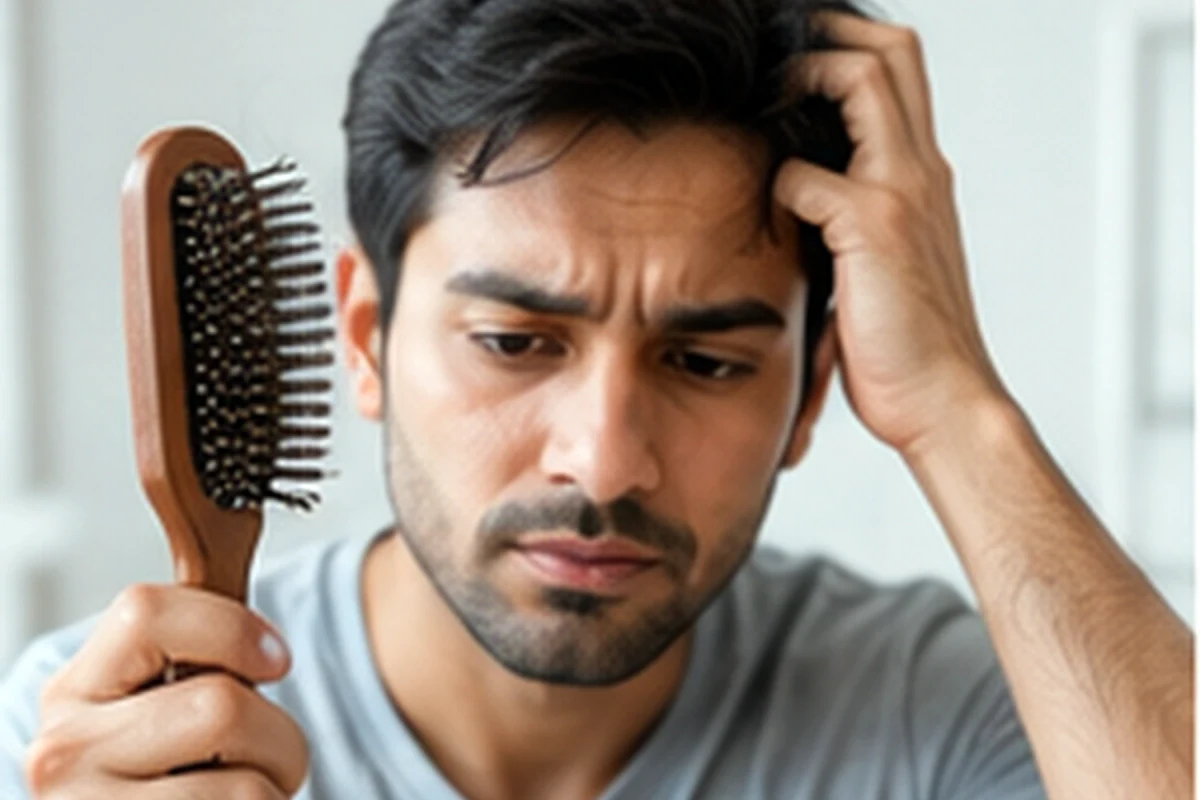
Dandruff can be surprisingly frustrating.
The flakes improve for a few days or weeks. The scalp feels cleaner and the itching settles. Treatment or an anti-dandruff routine is stopped.
Then the flakes gradually appear again.
For some people, the returning dandruff is accompanied by an oily or sticky scalp, itching, greasy roots, increased hair shedding and hair lengths that feel dry, rough or frizzy.
This often starts another round of experimentation with shampoos, oils, conditioners, serums, supplements, shower filters or home remedies.
But recurring dandruff raises a more useful question than simply asking which shampoo to try next:
Understanding that question may help make sense of the confusing combination of dandruff, scalp oiliness, frizz, humidity, water concerns and hair shedding.
> This article provides general educational information. It is not intended to diagnose an individual scalp or hair condition or replace evaluation by a qualified healthcare professional.
Dandruff Can Improve and Still Come Back
It is easy to assume that dandruff should behave like a one-time problem:
However, some conditions that produce persistent scalp flaking do not necessarily behave this way.
Seborrheic dermatitis, for example, is described in dermatology literature as a condition that can follow a recurring or relapsing course. A 2023 review in Skin Appendage Disorders describes scalp seborrheic dermatitis as a chronic inflammatory condition in which symptoms can recur over time.[1]
Earlier systematic reviews have also reported recurrence after treatment.
This means that the return of flakes does not automatically prove that a previous intervention was ineffective. In some cases, symptoms may have been controlled temporarily while the underlying tendency to develop them remained.
For people with recurrent symptoms, long-term management may therefore be different from simply treating one episode and assuming that the problem can never return.
Why Does Dandruff Keep Returning?
Dandruff is more complicated than excess oil or an unclean scalp.
Research suggests that several factors may interact, including:
- scalp sebum,
- microorganisms that normally live on the skin,
- individual susceptibility,
- the condition of the scalp's outer skin barrier,
- and inflammatory responses.
A comprehensive dermatology review by Borda and Wikramanayake discussed the interaction between sebaceous secretions, Malassezia yeasts, epidermal-barrier function and individual susceptibility in dandruff and seborrheic dermatitis.[2]
Importantly, Malassezia can also be present on healthy skin.
The presence of these yeasts alone therefore does not mean that a person will develop dandruff.
Similarly, an oily scalp alone does not explain every case.
The way the scalp environment, skin barrier, microorganisms and individual response interact appears to be more important than any single factor.
Persistent flakes should therefore not automatically be interpreted as evidence of poor hygiene.
Frequent cleansing can remove oil and visible scales, but scalp flaking may involve biological processes that cannot be explained simply by how often somebody washes their hair.
That is one reason why two people with apparently similar hair-care routines can have very different scalp experiences.
How Can the Scalp Be Oily While the Hair Is Dry and Frizzy?
This combination sounds contradictory but is entirely possible.
A person's scalp may become oily quickly while the middle lengths and ends of the hair remain:
- dry,
- rough,
- frizzy,
- puffy,
- tangled,
- or difficult to manage.
The reason is simple:
The scalp is living skin and contains sebaceous glands that produce sebum.
The visible hair shaft is largely made of keratin. Once hair has emerged from the follicle, its cosmetic condition can be affected by weathering, friction, heat, chemical treatment, grooming practices and environmental moisture.
A person can therefore have:
Describing the entire head simply as having either “oily hair” or “dry hair” may miss this distinction.
The Oily-Scalp and Dry-Hair Cycle
This combination can produce a frustrating routine.
The scalp becomes oily and flaky.
A stronger cleanser is used.
The scalp feels cleaner, but the hair lengths feel drier.
More conditioner, serum or oil is added to improve the lengths.
The hair feels smoother, but the roots may feel greasy sooner.
The hair is washed more aggressively again.
The scalp feels cleaner, but the lengths become rougher.
Another product is purchased.
And the cycle repeats.
This does not necessarily mean that a person simply has not found a strong enough shampoo.
It may mean that .
A product chosen primarily to address scalp flaking is not automatically expected to solve frizz, weathering, fibre damage and dryness at the ends of the hair.
Not Every Flaky Scalp Is the Same
Seeing white or yellow flakes does not establish their cause.
Flaking can occur with several scalp conditions, including dandruff and seborrheic dermatitis, but other disorders can sometimes produce similar symptoms.
Depending on the appearance and accompanying symptoms, a professional may need to distinguish scalp flaking from conditions such as:
- dry-skin scaling,
- irritant or allergic reactions,
- psoriasis,
- seborrheic dermatitis,
- fungal scalp infections,
- or other inflammatory scalp disorders.
This distinction becomes particularly relevant when symptoms are unusually severe, persist for a long time or fail to improve despite repeated attempts at treatment.
The safest approach is therefore not to assume:
Does an Oily Scalp Cause Dandruff?
Scalp oil can be part of the environment in which dandruff develops, but the relationship is not as simple as:
Research reviews have noted that sebaceous activity, Malassezia organisms, skin-barrier integrity and individual susceptibility can all contribute to the condition.[2]
That helps explain why someone with an oily scalp may never develop substantial dandruff, while another person may experience recurrent flaking.
The scalp should therefore be considered as an ecosystem rather than simply an oily or dry surface.
What About an Itchy Scalp?
Itching commonly accompanies dandruff and seborrheic dermatitis, but itching alone does not establish the diagnosis.
Persistent scalp itching can also occur with other dermatological conditions.
If itching is intense, accompanied by marked redness, pain, crusting, sores, thick plaques or patchy hair loss, it deserves closer evaluation rather than automatically being treated as routine dandruff.
Dandruff and Hair Shedding Are Not Necessarily the Same Problem
Another common concern occurs when dandruff is followed by noticeable hair shedding.
Someone may see:
- additional hair during shampooing,
- strands on the pillow,
- hair while combing,
- or increased shedding during the day.
It is understandable to connect the two events.
However, the everyday phrase can describe several different processes.
A complete hair is released from its follicle.
The hair fibre snaps somewhere along its length.
Individual hairs may gradually become finer or overall density may decrease.
Changes may become noticeable around the temples, frontal hairline, crown or parting.
These processes should not automatically be treated as identical.
Some dermatology literature discusses associations between significant scalp inflammation and increased shedding, while other reviews emphasize that seborrheic dermatitis is not itself a standard explanation for permanent patterned hair loss.[1][2]
The safest conclusion is therefore:
A person experiencing both may have more than one process occurring simultaneously.
Is Hard Water Causing Hair Problems?
Water is frequently blamed when someone's hair changes after moving to another house, neighbourhood or city.
People may notice:
- rougher hair,
- poorer manageability,
- more tangling,
- a change in shampoo performance,
- increased mineral residue,
- more breakage,
- or a different scalp feel.
There is a plausible reason why water chemistry can affect hair feel.
Hard water contains greater amounts of dissolved minerals, particularly calcium and magnesium salts.
However, the scientific evidence about hard water and hair damage is mixed.
What research has found
A 2013 study comparing hair exposed to hard water with hair exposed to distilled water for 30 days did find a statistically significant difference in tensile strength or elasticity.[3]
A 2016 experimental study using a longer hard-water exposure reported lower tensile strength in the hard-water-treated hair samples.[4]
A further 2018 experimental study also reported lower measured strength after hard-water treatment and discussed increased susceptibility to hair breakage.[5]
These studies examined the .
They do not establish that hard water causes androgenetic alopecia, permanently damages hair follicles or universally causes clinical hair loss.
Therefore, neither of these statements is adequately supported:
or
A more cautious interpretation is:
That distinction matters.
Breakage and Hair Loss Can Look Similar
When water, weather or styling makes hair feel fragile, somebody may notice more hair-like material around the bathroom or comb.
But breakage and follicular shedding are different processes.
Useful questions include:
- Are full-length hairs being shed?
- Are shorter fragments breaking?
- Has the hairline changed?
- Is the crown becoming more visible?
- Is the parting becoming wider?
- Is overall density changing?
- Or has the hair mainly become rougher and more fragile?
These observations do not replace diagnosis, but they help explain why the phrase “hair fall” can sometimes hide different underlying problems.
Humidity Can Affect Hair Behaviour
Anyone with frizz-prone hair may notice that hair behaves differently indoors and outdoors.
Hair can look controlled after washing and styling but become puffy or frizzy in humid weather.
This has a physical basis.
Human hair interacts with moisture in the surrounding air.
Research examining hair fibres has demonstrated that relative humidity can alter their mechanical and viscoelastic behaviour.[6]
A broader study of the structure and mechanics of human hair also reported that mechanical properties vary with relative humidity.[7]
The practical result is that environmental moisture can change the way the hair fibre behaves.
This can contribute to:
- swelling,
- changes in shape,
- loss of a smooth appearance,
- and greater frizz in susceptible hair.
Humidity therefore affects the differently from the way scalp oil affects the .
Why Can Humid Weather Produce an Oily Scalp and Frizzy Hair at the Same Time?
This is another combination that appears contradictory but makes sense when the scalp and hair lengths are considered separately.
During hot or humid conditions, the scalp may feel:
- sweaty,
- greasy,
- sticky,
- itchy,
- or uncomfortable.
Meanwhile, the hair fibre is interacting with moisture in the surrounding air and may become:
- puffy,
- frizzy,
- rough-looking,
- difficult to style,
- or less manageable.
So someone may experience:
These symptoms do not necessarily have a single cause.
What Have Newspapers Reported About Seasonal Hair Problems?
Health reporting has also highlighted these concerns.
For example, a 2024 Indian Express health article written by a dermatologist discussed increased scalp oiliness and changes in hair manageability during humid monsoon conditions.[8]
Such newspaper articles can be useful for illustrating commonly encountered seasonal concerns, but they should be understood differently from scientific research papers.
A newspaper health article is , not the same level of evidence as a controlled scientific study or systematic review.
For questions about the physical effects of humidity on hair, research studies on hair fibres provide stronger scientific support.[6][7]
Should a Dandruff-Prone Scalp Be Oiled?
There is no simple rule that applies to everyone.
One source of confusion is that a person may have dry hair lengths and automatically assume that the scalp must also need additional oil.
But:
Someone can have dry, weathered or frizzy ends while the scalp already produces substantial sebum.
Because dandruff and seborrheic dermatitis involve interactions between several biological factors, universal statements such as these are too broad:
or
The effect can depend on:
- the actual scalp condition,
- hair type,
- products being used,
- quantity and frequency,
- and individual response.
If scalp oiling consistently appears to worsen itching, redness, flaking or discomfort, that pattern is worth discussing with a qualified professional.
How Often Should an Oily, Dandruff-Prone Scalp Be Washed?
This is another question with no single answer for every person.
A very oily scalp may behave differently from:
- a dry scalp,
- tightly curled hair,
- chemically treated hair,
- damaged hair,
- or an inflammatory scalp condition.
Washing too infrequently may feel uncomfortable for some people with substantial oil buildup.
On the other hand, aggressive cleansing can make already dry or damaged lengths feel rougher.
The appropriate routine therefore depends on both:
and
General internet rules about washing frequency should not automatically replace individualized advice when scalp disease is persistent.
Why Can Anti-Dandruff Care Leave Hair Feeling Rough?
Scalp care and cosmetic hair care perform different functions.
A product selected primarily to address:
- scalp scaling,
- excess oil,
- microorganisms,
- or inflammation
may not provide enough conditioning for dry or weathered hair lengths.
This is why it can be useful to think about different zones.
Concerns may include oiliness, itching, flaking, redness and scalp disease.
Concerns may include dryness, friction, tangling, damage and breakage.
Concerns may include humidity response, fibre condition and manageability.
Expecting one shampoo to simultaneously control scalp disease, remove excess oil, repair damaged fibres and completely eliminate frizz may lead to unrealistic expectations.
The Product-Switching Cycle
Recurring symptoms can easily produce a cycle like this:
anti-dandruff product
→ symptoms improve
→ symptoms return
→ stronger cleanser
→ hair feels dry
→ heavier conditioner or oil
→ scalp feels greasy
→ another shampoo
→ shower filter
→ serum
→ supplements
→ another anti-dandruff product.
Eventually, many products may have been tried without answering the most important question:
The missing step may sometimes be not another product but better identification of the problem.
A More Useful Framework for Recurring Dandruff
Instead of thinking only about removing today's flakes, it can be helpful to think in four broad stages.
1. Identify
First determine what seems to be happening.
Is the main issue:
- ordinary dandruff,
- persistent oily scaling,
- dry flaking,
- seborrheic dermatitis,
- irritation,
- another inflammatory condition,
- or something else?
If there is hair loss, also distinguish between apparent breakage, shedding and progressive thinning.
2. Control
Once the likely problem has been identified, the goal is generally to control active symptoms such as:
- flaking,
- itching,
- excessive oiliness,
- redness,
- irritation,
- or inflammation.
The appropriate approach depends on the diagnosis and should not be assumed from flakes alone.
3. Protect the Hair Fibre
Managing a scalp condition does not automatically solve:
- dry ends,
- roughness,
- weathering,
- breakage,
- or humidity-related frizz.
Those hair-fibre concerns may need to be considered separately.
4. Think About Recurrence
For scalp conditions that naturally relapse, improvement does not necessarily mean that recurrence is impossible.
Research reviews of scalp seborrheic dermatitis specifically describe its tendency to recur.[1]
When symptoms repeatedly disappear and return, the useful question becomes:
That is different from repeatedly beginning the same product-search process from zero.
When Should Persistent Dandruff or Scalp Symptoms Be Evaluated?
Professional assessment becomes particularly important when:
- flaking repeatedly returns despite appropriate self-care;
- symptoms continue for months or years;
- scalp itching becomes intense or persistent;
- the scalp becomes markedly red, painful or inflamed;
- there are sores, crusting or drainage;
- scaling becomes unusually thick;
- there is patchy hair loss;
- substantial shedding occurs;
- overall hair density appears to decrease;
- the crown becomes progressively more visible;
- the hairline or temples appear to recede;
- several different products have been tried without clarity;
- or it is difficult to determine whether the problem is dandruff, another scalp disorder, breakage or actual hair loss.
These features do not establish a particular diagnosis, but they are reasons not to rely indefinitely on trial-and-error hair products.
The Main Question Is Not Always Which Shampoo to Buy
Recurring dandruff, oily scalp and frizzy hair can create an exhausting cycle.
Flakes improve.
Then they return.
The scalp becomes greasy.
Cleansing becomes more aggressive.
The lengths become rough.
More oil or conditioner is used.
The roots feel greasy again.
Hair shedding becomes worrying.
Water gets blamed.
Humidity gets blamed.
Another product gets purchased.
And the process begins again.
Instead, it may be more useful to ask:
The current scientific literature supports a more nuanced view of dandruff than simply “dirty scalp,” “too much oil” or “bad water.”
Dandruff and seborrheic dermatitis appear to involve interactions between skin biology, sebum, microorganisms, the scalp barrier and individual susceptibility.[1][2]
Environmental conditions can also influence the physical behaviour of the hair fibre, but those effects should not automatically be confused with diseases that cause progressive hair loss.[3–7]
The aim should therefore not simply be to remove visible flakes for a few days.
A more useful goal is to understand the complete pattern:
References and Further Reading
Leroy AK, Cortez de Almeida RF, Obadia DL, Frattini S, Melo DF. Scalp Seborrheic Dermatitis: What We Know So Far. Skin Appendage Disorders. 2023;9(3):160–164. DOI: 10.1159/000529854. PMID: 37325288.
Borda LJ, Wikramanayake TC. Seborrheic Dermatitis and Dandruff: A Comprehensive Review. Journal of Clinical & Investigative Dermatology. 2015;3(2). DOI: 10.13188/2373-1044.1000019. PMID: 27148560.
Srinivasan G, Srinivas CR, Mathew AC, Duraiswami D. Effects of Hard Water on Hair. International Journal of Trichology. 2013;5(3):137–139. DOI: 10.4103/0974-7753.125609. PMID: 24574692.
Luqman MW, Ali R, Khan Z, et al. Effect of Topical Application of Hard Water in Weakening of Hair in Men. Journal of the Pakistan Medical Association. 2016;66(9):1132–1136. PMID: 27654734.
Luqman MW, Ramzan MH, Javaid U, et al. To Evaluate and Compare Changes in Baseline Strength of Hairs after Treating Them with Deionized Water and Hard Water and Its Role in Hair Breakage. International Journal of Trichology. 2018;10(3):113–117. DOI: 10.4103/ijt.ijt_115_16. PMID: 30034190.
The Influence of Humidity on the Viscoelastic Behaviour of Human Hair. PubMed PMID: 12775909.
Structure and Mechanical Behavior of Human Hair. PubMed PMID: 28183593.
Mahajan DM. Monsoon Hair Fall: Why These Hacks Can Keep Bad Hair Days Away. The Indian Express, 11 July 2024. Included here as contextual dermatologist commentary rather than primary scientific evidence.
Editorial and Copyright Note
The scientific findings in this article have been summarized and paraphrased in original language. No research-paper tables, figures, photographs, abstracts or substantial passages have been reproduced.
The newspaper reference is summarized for contextual purposes; no newspaper photograph, graphic or substantial passage has been reproduced.
Research references are provided so readers can identify the underlying sources.
This article is educational and should not be interpreted as individualized medical advice, diagnosis or a guarantee of treatment outcome.